
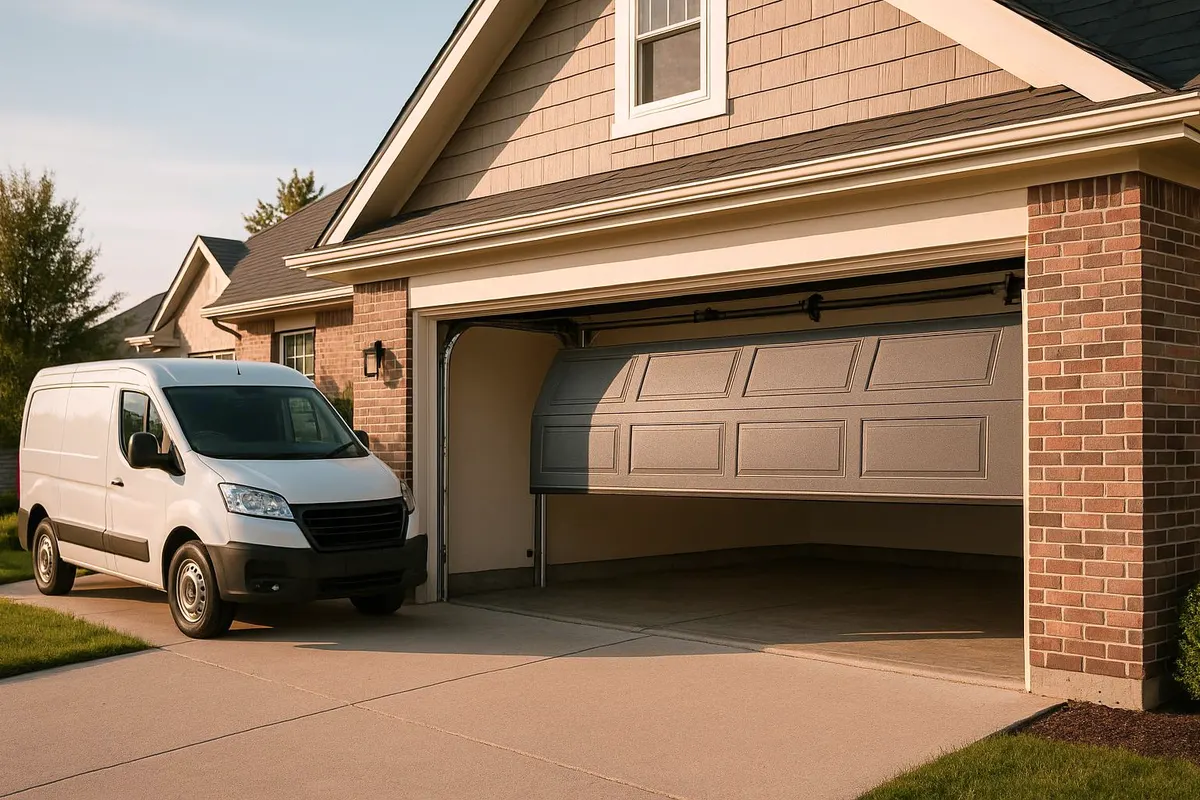
A garage door won't hold up against straight-line winds or a storm's sudden pressure changes unless it's properly balanced, reinforced, and sealed. That's because it's the largest moving opening in your home's exterior wall, built from thin steel panels riding in a track — not studs and sheathing. When wind gets under it or slams against it, it's often the first thing to fail, and once it fails, wind pressure can push into the garage and stress the roof structure from the inside.
Why the Garage Door Gives Out Before the Rest of the House
Every other wall in a typical home is a solid, braced assembly. The garage door is the opposite: a wide panel held in place by rollers, tracks, and a spring system designed to manage weight, not lateral force. In older homes across Dearborn Heights and the surrounding area, many doors were installed decades ago with standard hardware that was never rated for wind load. Add in a detached or attached garage with a long, unbroken wall of door, and you've got the single most vulnerable point on the house during a storm.
This matters right now because fall in southeast Michigan brings some of the year's strongest wind events — fast-moving fronts, gusty thunderstorms, and the kind of sideways rain that tests every seal on a house before winter sets in for good.
What Wind Stress on a Garage Door Actually Looks Like
- Visible flexing or bowing in the panels during gusts — a sign the door lacks horizontal bracing
- Daylight gaps along the bottom seal or sides, letting wind-driven rain in
- Track brackets pulling slightly away from the wall or jamb
- The opener straining or reversing on its own when wind pressure changes as the door closes
- A door that feels heavier or lighter than usual when lifted manually, which usually points to a spring losing tension, not the wind itself — but a poorly balanced door is far more likely to rack sideways and jump the track under load
Fall Storm Prep Checklist
Before the next round of severe weather rolls through, walk through these steps. Most take under an hour.
- Tighten the track hardware. Lag bolts and brackets loosen over time from normal vibration. A loose track is the most common reason a door pulls free in high wind.
- Check the bottom seal and weatherstripping. Cracked or flattened rubber lets wind-driven rain and cold air in; it's a cheap fix that prevents bigger problems once temperatures drop.
- Test the auto-reverse safety sensors. Wind gusts during a closing cycle can trigger false reversals or, worse, mask a real obstruction. Confirm they're aligned and responsive.
- Lubricate rollers and hinges. A door that moves smoothly puts less strain on the track during wind-driven vibration.
- Check the spring balance. Disconnect the opener and lift the door manually halfway — it should stay in place. If it drops or shoots up, the springs are off, and an unbalanced door is more likely to rack or buckle under wind pressure.
- Have a plan for power outages. Storm season means outages. Know how to manually release the opener so you can close the door by hand if the power drops mid-storm.
Reinforcement Options Worth Considering
If your garage sits on an exposed lot, faces open wind corridors, or you've noticed repeated flexing in past storms, a few upgrades are worth the trade-off:
- Retrofit strut kits add horizontal steel bracing to an existing door without full replacement — lower cost, moderate improvement
- Heavier-gauge tracks and reinforced end brackets hold up better to repeated gust cycles than the standard hardware many builders used
- Wind-rated replacement doors are the strongest option but carry a higher upfront cost, typically landing in the same general range as a standard high-quality insulated door plus a premium for the rated hardware
When to Call Dearborn Heights Garage Door
If your door is flexing visibly in wind, the track has pulled away from the wall, or the door won't stay balanced when you test it manually, that's not a wait-and-see issue — a compromised door in a severe wind event can fail completely. Our Garage Door Maintenance service covers the full inspection: hardware tightness, spring balance, seals, and opener function, so you know exactly where your door stands before storm season peaks. If the springs are worn or the door needs bracing beyond a simple tune-up, our Spring Replacement and reinforcement work gets it back to solid before the next front moves through.
Call Dearborn Heights Garage Door today to get your door storm-ready — serving Dearborn Heights, Dearborn, Garden City, Inkster, Westland, Taylor, Allen Park, and Redford Township.